A storm-damaged tree is usually worth saving when the trunk is sound and less than about half of the crown is lost. It is usually safer to remove when the trunk is split or leaning on a new angle, large limbs are broken at the trunk, or the roots have lifted.
After a Kentucky ice storm or a line of summer thunderstorms, the first question is rarely about biology. It is whether the tree can stay where it is. University extension forestry programs, including those in Kentucky, Iowa, Missouri and Purdue, give homeowners the same basic triage, laid out below.
Safety first: what to check before touching anything
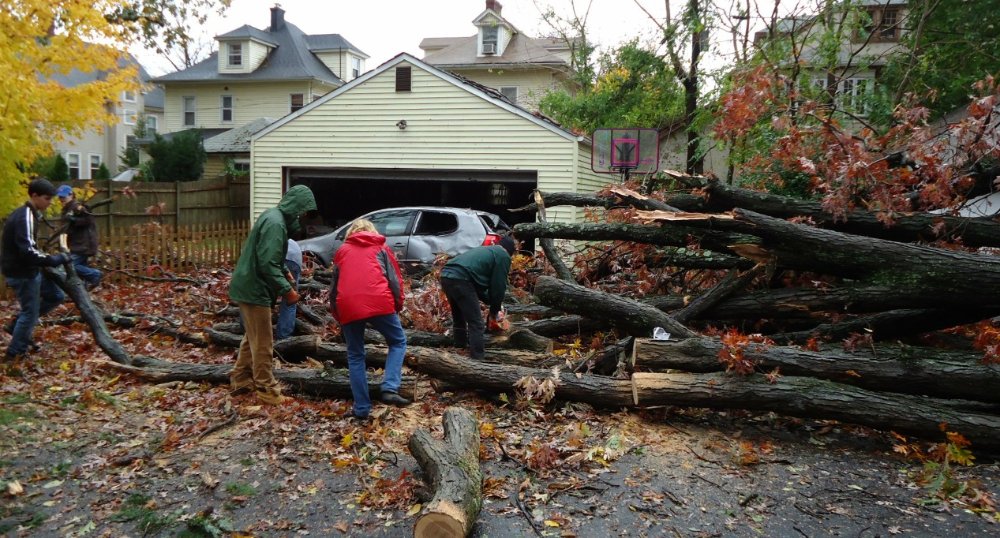
Hazards come before decisions. Hanging limbs, tangled branches and cracked trunks can shift without warning, and the weight involved is far greater than it looks. Extension foresters consistently advise staying out from under damaged crowns and treating any tree touching a utility line as energized. Calling the utility and keeping people and pets clear comes first, and the tree can wait.
Chainsaw work on storm debris is a leading source of post-storm injuries because wood under tension can spring or roll when cut. Work that involves climbing, rigging or a tree under load is the kind of job the ANSI Z133 safety standard was written for, as covered in the overview of ANSI Z133 arboricultural safety.
What can usually be saved
Trees are better at recovering than most owners expect. Extension guidance from the University of Kentucky and Iowa State describes a tree as a good candidate to keep when most of the following hold:
- The main trunk is intact, with no deep splits or cracks.
- More than half of the crown is still alive and balanced.
- The broken limbs are small enough to prune back to a clean cut at the branch collar.
- The species tolerates storm loss, such as oak, which tends to hold up better than silver maple or Bradford pear.
- The tree was healthy and structurally sound before the storm.
Ragged breaks should be pruned back to a proper cut rather than left as stubs. Flush cuts and “topping” create weakly attached regrowth that fails in the next storm. The tree trimming page explains what a proper structural prune looks like, and the guide to the best time to trim trees in Kentucky covers timing for follow-up work.
Signs that removal is the safer call
| What is visible | Why it matters |
|---|---|
| Split or cracked trunk | The structural core is compromised and cannot heal back to full strength. |
| More than half of the crown lost | The tree has too little leaf area left to feed itself and rebuild. |
| Roots lifted or soil heaved on one side | Anchorage is gone even if the tree is still standing. |
| New lean after the storm | A sudden lean is a different problem from a long-standing one. See the guide to leaning trees. |
| Large limbs broken at the trunk | Big wounds at the trunk invite decay and rarely seal well. |
| Dead or hanging branches over a house, car or line | The consequence of a failure is high, which lowers the tolerance for risk. |
Trees that were already declining are harder to judge after a storm. The guide to telling if a tree is dead covers the checks that separate storm damage from older decline.
Insurance, cleanup and what to do next
Photographs taken before anything is moved make later claims simpler. Coverage for tree removal depends on the policy and on what the tree hit, which the homeowners insurance and tree removal guide walks through. Ice storm recovery has its own pattern, described in the guide to protecting trees from ice storm damage.
Where a tree has to come down, the stump is the part that stays behind. The stump grinding page explains how it is cleared once the trunk is gone.
Frequently asked questions
How do I know if a storm-damaged tree can be saved?
Look at the trunk, the crown and the roots. A sound trunk with more than half of the crown intact and no root lift is generally worth keeping, while a split trunk, heaved roots or a new lean point toward removal.
How soon should a damaged tree be dealt with?
Anything hanging over a home, a driveway or a line should be handled quickly and by trained crews. A damaged tree standing in an open yard can usually wait for a proper assessment.
Is topping a good way to fix storm damage?
Extension foresters advise against topping. It leaves large wounds and produces weak shoots that break easily, which makes the next storm worse.
Does homeowners insurance cover storm tree removal?
It depends on the policy and on whether the tree struck a covered structure. Reading the policy and documenting damage with photographs before cleanup are the usual first steps.
Need a second opinion on a damaged tree?
Central Ky Tree Service looks at storm-damaged trees across the Lexington area and gives a straight answer on whether a tree can stay. Start with the tree removal page or, if something is down right now, the emergency page.
Sources
- University of Kentucky Extension, timber and storm damage guidance: forestry.ca.uky.edu
- Iowa State University Extension and Outreach: extension.iastate.edu
- University of Missouri Extension: extension.missouri.edu
- Purdue University Extension, Forestry and Natural Resources: extension.purdue.edu