
To tell if a tree is dead, scratch a twig with a fingernail: green underneath means living tissue, while brown and dry means that part is dead. Bend a young twig; a live one flexes and a dead one snaps. Then check buds, bark and the base. In late fall and winter, when every hardwood in Central Kentucky stands bare, those checks matter more than how the tree looks from the street.
This guide covers the tests that work in any season, the winter look-alikes that fool homeowners every year, the special case of ash trees, and the point at which a dead or dying tree stops being a yard problem and becomes a safety problem.
Why dead and dormant look the same in winter
A healthy maple in January and a dead one in January share the same silhouette: no leaves, gray bark, bare twigs. Dormancy is the tree’s normal winter shutdown, and it removes the most obvious clue people rely on the rest of the year.
In Lexington that leaf-off season is long. NOAA’s 1991 to 2020 climate normals for Blue Grass Airport put the average number of nights at or below freezing at 11.0 in November, 19.3 in December, 22.7 in January, 19.2 in February and 13.1 in March, close to 90 freezing nights a year in total. From roughly Halloween to early April, a dead tree can hide among the dormant ones.
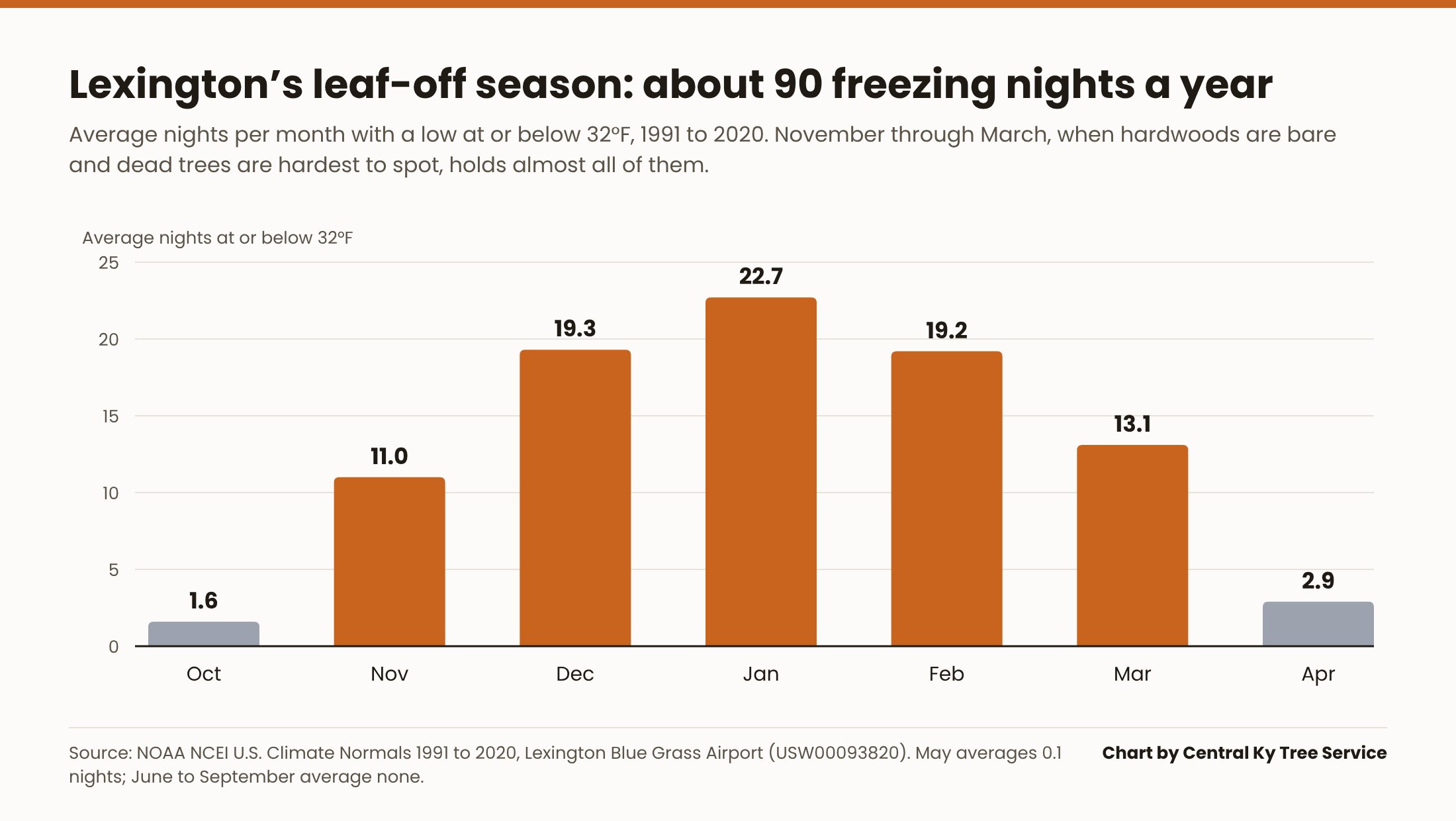
Winter is also when the questions get urgent. Snow, ice and wind arrive in the same months, and the University of Kentucky’s Department of Forestry and Natural Resources notes in its hazard tree fact sheet that heavy winds snap off inflexible dead branches. A dead limb that would have hung on quietly through summer is far more likely to come down in February.
Five checks that work in any season
None of these require tools beyond a pocketknife and a pair of eyes. Check several branches on different sides of the tree, because a tree can be dead in one section and alive in another.
1. The scratch test
Lindsey Purcell, urban forestry specialist at Purdue University, recommends lightly scratching the bark with a thumbnail on any branch or stem that shows no buds or leaves. A green layer underneath suggests the tree is alive and simply slow to come out of dormancy. No green tissue suggests that part is dead.
Start near the tips and work inward toward the trunk. If the tips are brown and dry but green shows up a foot or two back, the outer twigs died and the branch itself is still living.
2. The snap test
NC State Extension’s Caswell County Center describes bending a one-year-old twig to a right angle. A live twig bends. If the twig breaks, the tree is most likely dead. The University of Kentucky hazard tree fact sheet describes dead branches the same way, as inflexible, which is why they are the first to snap in heavy wind.
3. The bud check
The same NC State Extension guidance points to the buds on new twigs: buds that are dry rather than green can show that a tree has died before other symptoms appear. Compare buds on the questionable branch with buds on a branch that leafed out normally last spring.
4. Bark that is loose or falling off
The University of Kentucky hazard tree fact sheet (FORFS 17-02, produced with the Kentucky Division of Forestry) lists loose bark among the warning signs. Combine it with the scratch test: where bark is loose, check whether the layer just beneath it is still green.
5. Fungus, sawdust and soft wood
The USDA Forest Service publication How to Recognize Hazardous Defects in Trees calls mushrooms, conks and brackets growing on the root flare, trunk or branches indicators of advanced decay. The University of Kentucky fact sheet adds sawdust piles or crumbling wood at the base, and wood that is soft, mushy or missing altogether. NC State Extension describes fungus and horizontal cracks as clear signs of a dead tree.
Winter look-alikes that are not dead
Brown leaves that hang on all winter
Some healthy trees keep their dead leaves until spring. Rutgers Master Gardeners of Hunterdon County describe this habit, called marcescence, in several oaks, beech, witch-hazel and hornbeam under normal conditions. According to the same source, the layer that releases each leaf only finishes forming in spring, and the leaves fall then. An oak or a beech rattling with brown leaves in January is usually doing exactly what its species does.
Evergreens that brown in late winter
Oklahoma State University Extension explains that winter desiccation happens when the soil is frozen and winter winds draw moisture out of evergreen foliage faster than the roots can replace it. The browning often shows only at tips or margins. Bill Fountain, extension professor of arboriculture at the University of Kentucky, wrote that when only the leaves are brown, those dead leaves will be shed and new foliage produced as spring growth begins. Run the scratch and bud checks on the twigs before deciding a browned evergreen is gone.
Trees that are slow to leaf out
Purcell’s Purdue guidance makes the same point for deciduous trees: a tree with green under the bark may simply be emerging from dormancy slowly. The same Purdue article notes that after a late freeze, damaged leaves usually drop and new leaves emerge somewhat slowly, so a living tree can look dead for a while in spring.
Dying is not the same as dead
A tree rarely dies all at once. NC State Extension notes that it may take several years for a tree to die from insect, disease or drought injury, and that root damage from grading or construction can take up to five years to finally kill a tree. Once that decline starts, the same source says it is almost impossible to reverse.
The University of Kentucky fact sheet lists dead branches in the canopy among the signs to look for, and the USDA Forest Service links twig dieback and dead wood in the crown to root problems. The University of Kentucky fact sheet explains that the presence of fine, small branches after leaf drop indicates a healthy tree, because those small branches are usually the first to break off when a tree is injured or dies. A crown that looks like a coat rack instead of a broom deserves a closer look.
When only part of a tree is dead, Purdue’s guidance is to prune the dead branches back to living wood and reassess. The tree trimming page explains how deadwood removal works, and the guide to the best time to trim trees in Kentucky covers why the dormant season suits most species.
Ash trees: the Central Kentucky special case
Any guide to dead trees in this part of the state has to deal with ash. The Kentucky Division of Forestry reports that emerald ash borer was first confirmed in Kentucky in 2009 and has since been confirmed in 105 of the state’s 120 counties, with mass mortality across the northeastern counties and decline spreading westward.
The scale shows up in the federal forest inventory. A 2017 University of Kentucky white paper, using USDA Forest Service Forest Inventory and Analysis data, counted 3,951,388 standing dead ash trees on Kentucky forest land in 2009 and 10,542,221 in 2015, an increase of 167 percent. Over the same period ash went from 3.6 percent to 8.2 percent of all standing dead trees in the state.
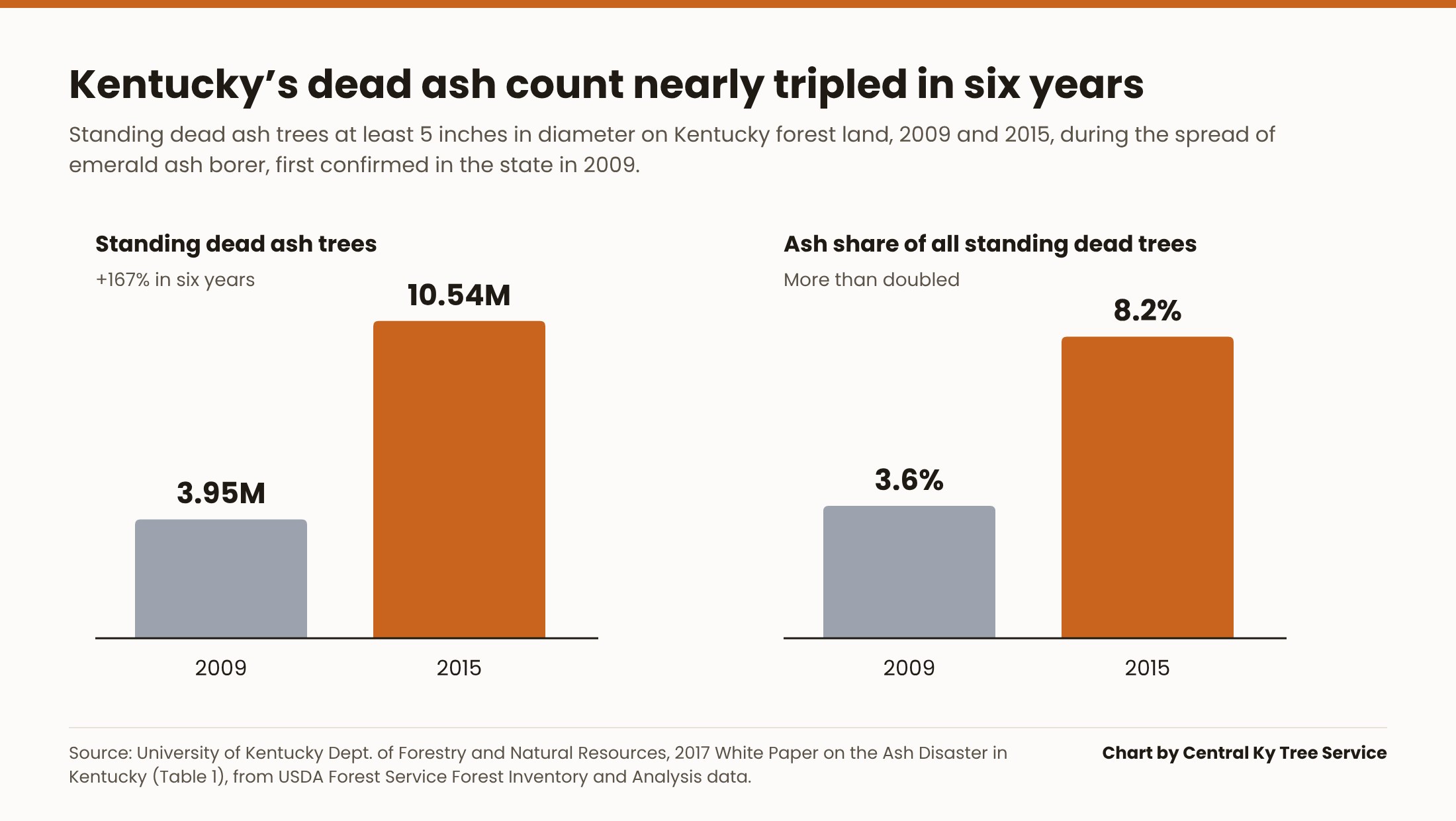
Dead ash is a bigger safety concern than most dead trees. Purdue University Extension warns that ash killed by emerald ash borer becomes extremely brittle and breaks easily, often with internal breaks hidden under the bark, and that delaying removal allows the tree to become more brittle and the problem more dangerous. Purdue advises planning removal once an ash has lost more than 30 percent of its canopy.
A New Jersey tree care worker risk alert on infested ash goes further: branches can snap or shatter under little stress, can shatter from chainsaw vibration, and a dead or dying infested ash should never be climbed. The emerald ash borer symptoms guide shows how to recognize an infested ash before it dies, and the emerald ash borer page covers treatment and removal options.
When a dead tree becomes a hazard
The USDA Forest Service is blunt about dead wood: dead trees and branches are unpredictable and can break and fall at any time, and dead branches or tops that have already broken off and are hung up in the canopy, known as hangers or widow makers, are especially dangerous. Its guidance treats large dead trees and branches as not negotiable.
The same publication defines a hazard tree by what it could hit. A tree with defects is not hazardous unless some portion of it is within striking distance of a target such as a house, a vehicle, or a place where people gather. A dead tree at the back of a pasture and a dead tree leaning over a driveway are two very different problems.
For living trees with decay, the USDA lists take-action thresholds. Among them:
- Less than 1 inch of sound wood for every 6 inches of trunk diameter at any point on the stem
- A canker, or several cankers, affecting more than half of the trunk’s circumference
- More than half of the roots under the crown cut or crushed, often during construction or trenching
- Two or more cracks in the same general area of the stem
- A lean with recent root exposure, soil movement or soil mounding near the base
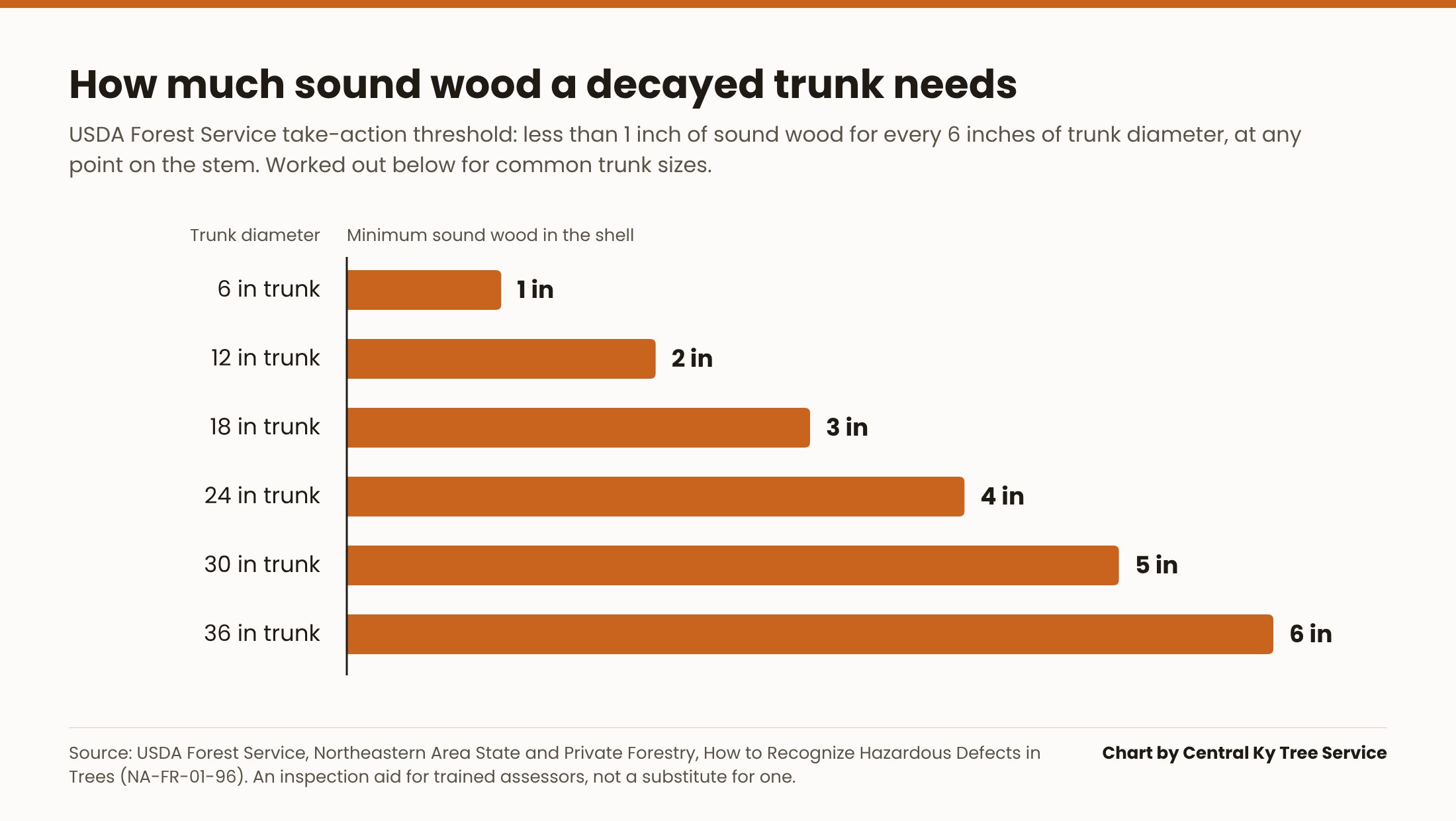
The shell rule is a judgment aid for trained inspectors rather than a homeowner measurement. The University of Kentucky fact sheet recommends consulting an ISA certified arborist or a forester whenever a tree is suspected to be hazardous. The guide to ISA tree care standards in Lexington explains what that credential means.
Why late fall is the time to look
The USDA Forest Service recommends inspecting trees every year, and to be thorough, after leaf drop in fall, after leaf-out in spring, and after severe storms. With the leaves gone, the structure is easy to see: dead limbs, cracks, hangers and a thinning crown are all visible from the ground in a way they are not in July.
Timing also matters because of what comes next. Central Kentucky’s ice storms load every branch in the canopy at once, and the University of Kentucky fact sheet notes that inflexible dead branches are the ones that snap. The guide to protecting trees from ice storm damage covers that mechanism in detail. A dead tree identified in November can be dealt with on a dry day. The same tree found on a roof in January becomes an emergency tree removal and, often, an insurance question; the guide to whether homeowners insurance covers tree removal in Kentucky explains how those claims usually work.
What to leave alone
Some dead trees should not be touched by a homeowner at all:
- Anything near power lines. OSHA’s electrical safety standard (29 CFR 1910.333) requires anyone who is not a qualified line worker to stay at least 10 feet from energized overhead lines of 50 kV or less, along with any conductive object they are holding.
- Hangers. A broken limb caught in the canopy can fall without warning, which is why the USDA singles it out.
- Dead ash. Its brittle wood can shatter during cutting, as the New Jersey risk alert describes.
- Trees on the public strip. Street trees in Lexington follow city rules. The guide to Lexington LFUCG tree regulations explains who is responsible for what.
Professional tree work falls under the ANSI Z133 safety standard, which the guide to ANSI Z133 arboricultural safety walks through.
Frequently asked questions
How can I tell if my tree is dead or just dormant in winter?
Scratch a twig with a thumbnail and bend a young twig. Purdue University Extension notes that green tissue under the bark means the tree is likely just dormant, and NC State Extension notes that a twig that snaps at a right angle points to a dead tree. Check several branches, since part of a tree can be dead while the rest is alive.
Can a dead tree come back to life?
A dead tree does not recover, but a partly dead tree can keep living from its healthy sections. Purdue University Extension’s guidance is to prune dead branches back to living wood and reassess. NC State Extension notes that once decline starts it is almost impossible to reverse.
How long can a dead tree stand before it falls?
There is no safe waiting period. The USDA Forest Service says dead trees and branches are unpredictable and can break and fall at any time, and Purdue University Extension warns that ash killed by emerald ash borer grows more brittle the longer it stands.
Do mushrooms on a tree mean it is dying?
Mushrooms, conks and brackets on the trunk, branches or root flare are indicators of advanced decay according to the USDA Forest Service. Decay does not always mean the tree is dead, but the University of Kentucky fact sheet says large amounts of rotten wood should not be ignored.
Is winter a good time to remove a dead tree?
Winter is when dead trees are easiest to spot and when snow, ice and wind make them most likely to fail. The USDA Forest Service also recommends an inspection after leaf drop, when dead limbs are easiest to see. The tree removal page covers what the work involves, and the stump grinding page covers what happens to the stump afterward.
Should I remove a dead ash tree right away?
Purdue University Extension advises planning removal once an ash has lost more than 30 percent of its canopy, because emerald ash borer damage makes the tree progressively more brittle and more dangerous to remove.
Not sure about a tree? Get it looked at
If a tree on your property failed the scratch or snap test, is dropping bark, or is an ash that has thinned out, Central Ky Tree Service can take a look before winter weather does the deciding. We handle dead tree removal, deadwood trimming and stump grinding across Lexington, Nicholasville, Georgetown, Versailles, Winchester, Richmond, Paris, Frankfort and the rest of our service area.
Request a free estimate, check our frequently asked questions, or call (859) 333-7246 to talk it through. If a dead tree is already down or hanging over the house, our emergency tree service is the place to start.
Sources
- NOAA National Centers for Environmental Information, U.S. Climate Normals 1991 to 2020, Lexington Blue Grass Airport (USW00093820)
- University of Kentucky Forestry and Natural Resources with the Kentucky Division of Forestry, Identifying Hazard Trees (FORFS 17-02)
- USDA Forest Service, Northeastern Area State and Private Forestry, How to Recognize Hazardous Defects in Trees (NA-FR-01-96)
- Purdue University Forestry and Natural Resources Extension, Cold Injury to Trees (Lindsey Purcell)
- Purdue University Forestry and Natural Resources Extension, Avoid Deadly Risk of Dying Ash Trees with Timely Tree Removal
- NC State Extension, Caswell County Center, Is My Tree Dying?
- Rutgers Master Gardeners of Hunterdon County, Why Some Trees Keep Their Leaves
- Oklahoma State University Extension, Winter Desiccation Injury of Evergreen Shrubs and Trees
- University of Kentucky Nursery Crop Extension, Cold Damage to Woody Ornamentals and What to Expect (William M. Fountain)
- Kentucky Division of Forestry, Forest Health Highlights 2024
- University of Kentucky Department of Forestry and Natural Resources, 2017 White Paper on the Ash Disaster in Kentucky
- New Jersey Department of Agriculture, Tree Care Worker Risk Alert: Working with Infested Ash Trees
- OSHA, 29 CFR 1910.333, Selection and Use of Work Practices