
The work that protects a tree from ice happens months before the ice arrives. Remove deadwood and obvious hazards this fall, get weak branch unions assessed, and schedule structural pruning for late winter. Once branches are already loaded with ice, there is nothing safe you can do except stay out from under them and wait for it to melt.
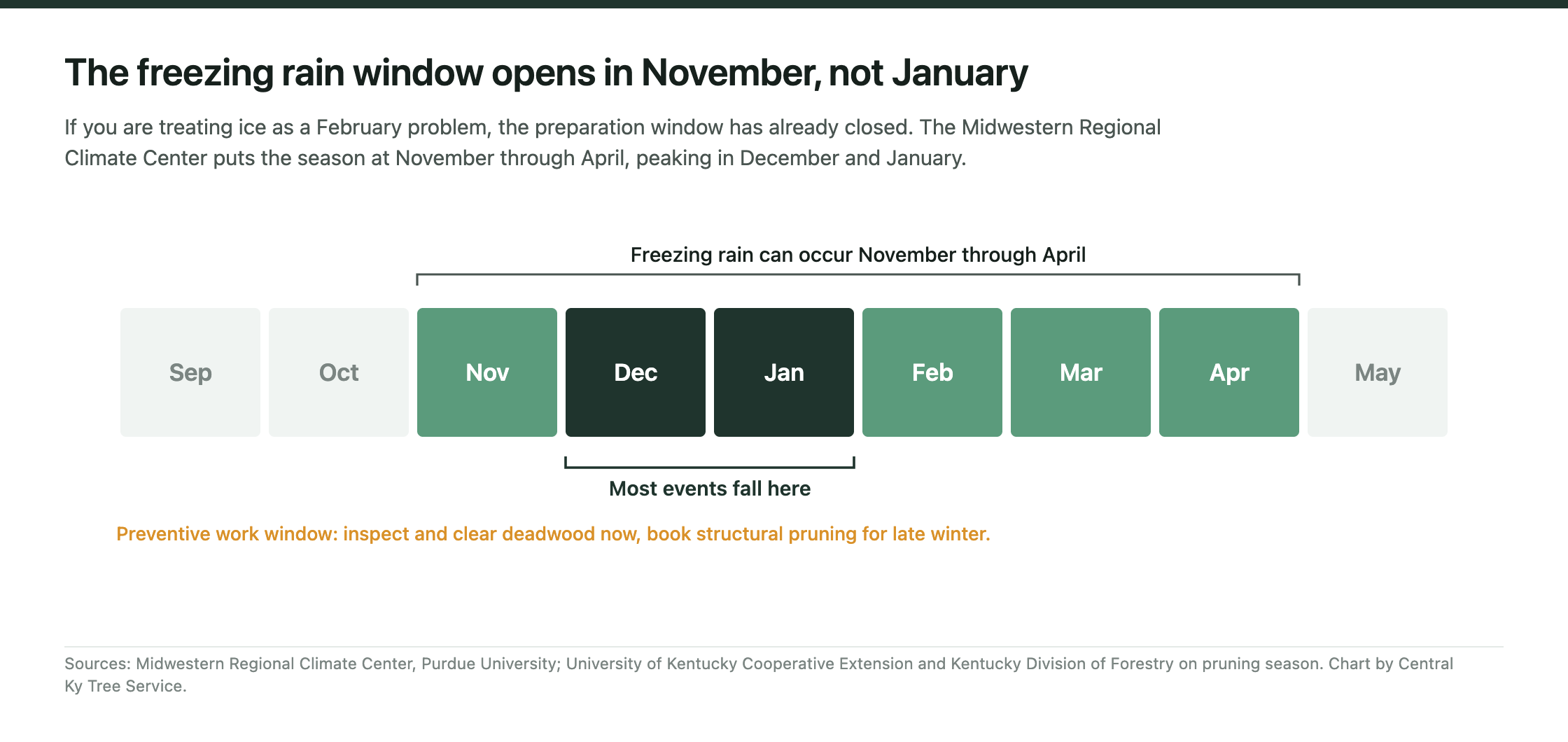
Central Kentucky sits in the part of the country where freezing rain is a normal feature of winter rather than a rare event. According to the Midwestern Regional Climate Center at Purdue University, freezing rain can occur anytime between November and April, with most events falling in December and January.
That is a wider window than most homeowners plan for. If you are thinking about ice as a February problem, you are roughly two months late.
What central Kentucky actually gets
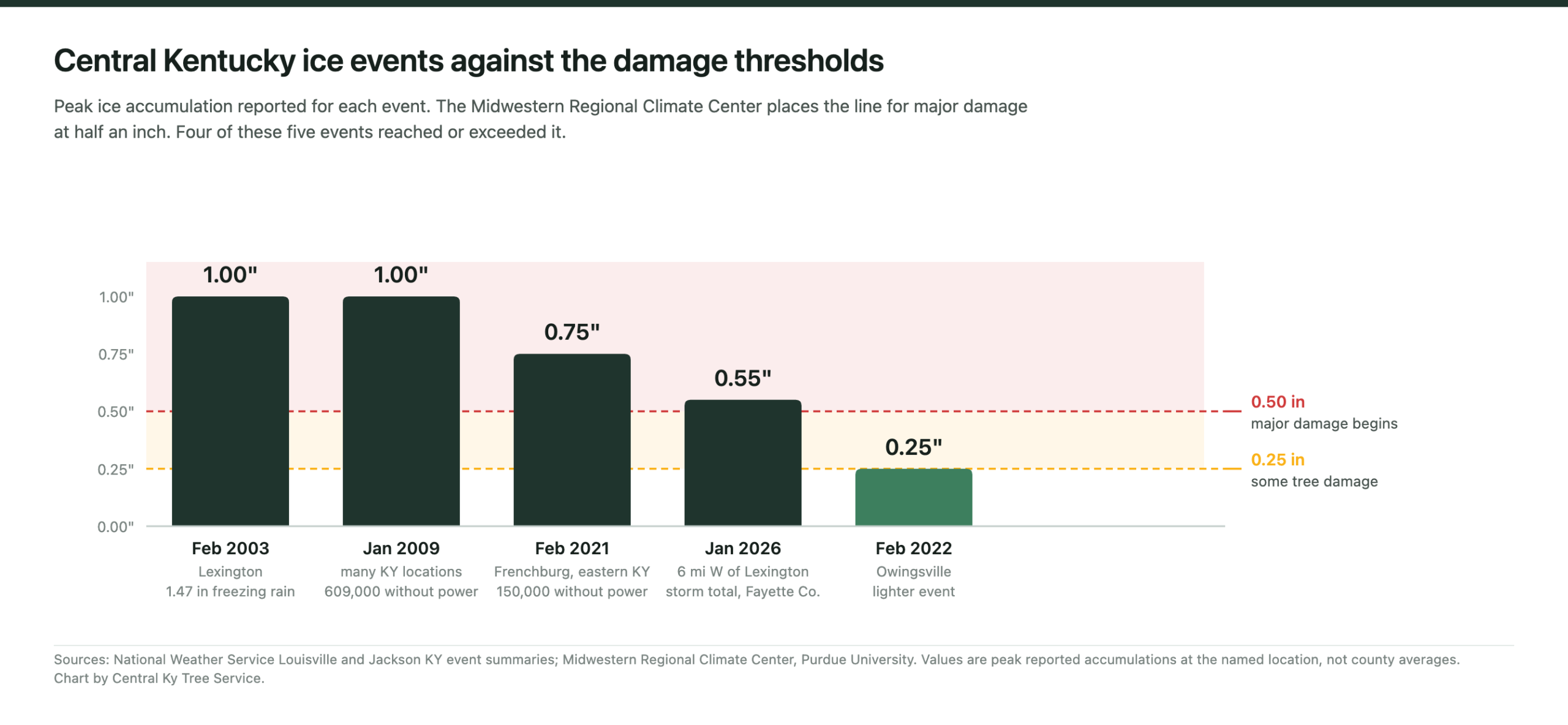
The benchmark local event is still the February 2003 storm, which the National Weather Service office in Louisville documented in a dedicated summary. Lexington recorded 1.47 inches of freezing rain, leaving roughly an inch of ice on exposed branches and sidewalks. Across the state 280,000 customers lost power, some for as long as a week. Utilities replaced 3,109 power poles and 799 transformers, at a repair cost of 47.2 million dollars, with about 26 million dollars more in municipal cleanup. The Weather Service records one death in Lawrenceburg, caused by a falling ice-covered tree limb.
The National Weather Service summary of that storm includes an account from a Lexington resident that describes the night better than any statistic: “Saturday night was very frightening. You could hear the trees groan, there’d be a snap and then a crash as the ice fell down.”
January 2009 was worse statewide. The National Weather Service in Louisville reports that 609,000 homes and businesses lost power, the largest power outage on record for Kentucky, with ice over an inch thick reported in many locations. The Weather Service notes that property damage was widespread and attributes it to falling trees, large tree limbs and power lines weighed down by ice.
It is not history, either. In the storm of January 24 to 26, 2026, the National Weather Service recorded a station six miles west of Lexington in Fayette County at 0.30 inches of ice in a single day and 0.55 inches for the storm total, with power outages across southern, central and eastern Kentucky peaking around 75,000.
That 0.55 inch figure matters, because of where it sits on the damage scale.
What half an inch of ice does to a branch
The Midwestern Regional Climate Center puts the thresholds plainly: “A quarter inch of ice will glaze roads and seriously impact travel, result in some tree damage, and cause power outages. However, when ice accumulates to one half inch or more the major and crippling effects of ice storms occur.”
The National Weather Service office in Louisville issues an Ice Storm Warning when a freezing rain event is expected to produce a quarter inch of ice or more. Lexington’s most recent significant event was more than double that.
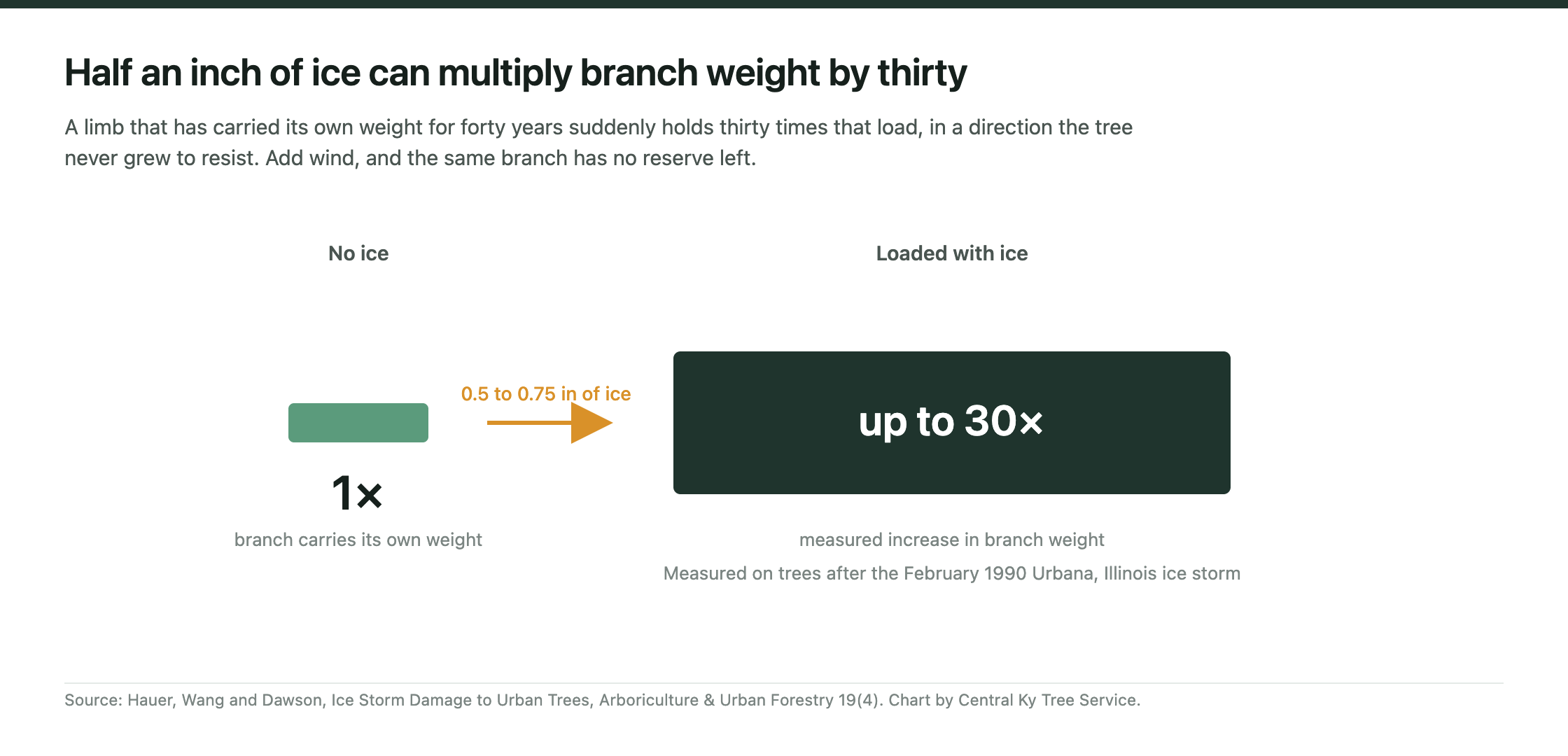
As for what the ice is doing mechanically, the best-sourced figure comes from field measurement rather than estimate. Hauer, Wang and Dawson, publishing in Arboriculture & Urban Forestry, measured trees after the February 1990 Urbana, Illinois ice storm and found that ice accretion of between half an inch and three quarters of an inch increased branch weight by up to 30 times.
Thirty times. A limb that has carried its own weight without complaint for forty years is suddenly holding thirty times that load, and it is holding it in a direction the tree never adapted to.
Purdue University Extension describes the two loading directions that matter: axial loading from snow or ice accretion, and lateral, side loading from wind. Ice presses a branch straight down. Wind pushes it sideways. A branch already at its structural limit under vertical ice load has no reserve left when a gust arrives, which is why the same amount of ice does far more damage on a windy night. The second edition of Trees and Ice Storms, published jointly by the University of Wisconsin-Stevens Point and the University of Illinois, identifies the three factors that determine damage as the amount of accumulated ice, exposure to wind, and the duration of the storm.
The four things that make a tree fail under ice
Here is the finding that changes how you should look at your own trees. It is almost never the wood that breaks. It is the joint.
The peer-reviewed study by Hauer, Wang and Dawson found no discernible overall relationship between wood specific gravity, modulus of rupture or modulus of elasticity and susceptibility to ice damage. In the University of Illinois extension publication drawn from that work, the authors put it directly: “The wood strength of sound branches matters less than the ability of a tree to withstand breakage at branch junctures.”
So a strong-wooded species with a bad branch union will fail, and a weaker-wooded species with clean architecture may not. Four structural faults account for most of what comes down.
Co-dominant stems with included bark
This is the classic failure point. Lindsey Purcell, writing in Purdue Extension publication FNR-550-W, describes co-dominant stems, or V-crotch branch unions, as structurally weak compared to a single stem or unions with proper branch aspect ratios and spacing. The cause is a lack of connective tissue anchoring the stem to the trunk, combined with bark growing in between the two stems instead of wood.
Purcell adds the detail that predicts risk: “The longer the codominant stems, the greater the likelihood of failure, especially on larger trees.” A big tree with two competing leaders that split near the base is the one to worry about first.
If you look up into your tree and see two trunks of roughly equal size forming a narrow V with a seam of bark pinched between them, you have found the weak point. That union will be where the tree comes apart.
Long overextended limbs and fine branching
The same research team found that a fine branching pattern, structural weakness and higher degrees of lateral branching were associated with greater incidence of ice damage. This makes intuitive sense once you think about surface area. Ice coats every twig, so a tree with dense fine branching is collecting far more ice per unit of structural strength than one with a coarser branch pattern.
Long limbs extending out over a driveway or roof are the other version of this problem. The further out the load sits, the more leverage it applies to the union holding it on.
Previously topped trees
Topping is the single worst thing that can be done to a tree that will later face ice. Purdue University Extension explains why: “Topped trees produce many small, poorly attached sprouts and as they grow, the canopy weight and density is actually increased,” and topped branches often develop decay and diseased stems.
Read that carefully, because it contains two separate problems. The regrowth is weakly attached, and there is more of it. Topping increases the ice-catching surface while degrading the attachments that have to hold it. The Kentucky Division of Forestry is blunt on the practice: “Topping or ‘de-horning’ a tree generally leads to tree decline and increased maintenance needs, so avoid these destructive practices.”
Decay, cavities and standing deadwood
The University of Illinois publication states the obvious risk plainly: “Decaying or dead branches are already weakened and have a high probability of breaking when loaded with ice.”
Deadwood is also the easiest of the four faults to fix, and the one that can be addressed at any time of year, including right now.
Which trees in your yard are most at risk
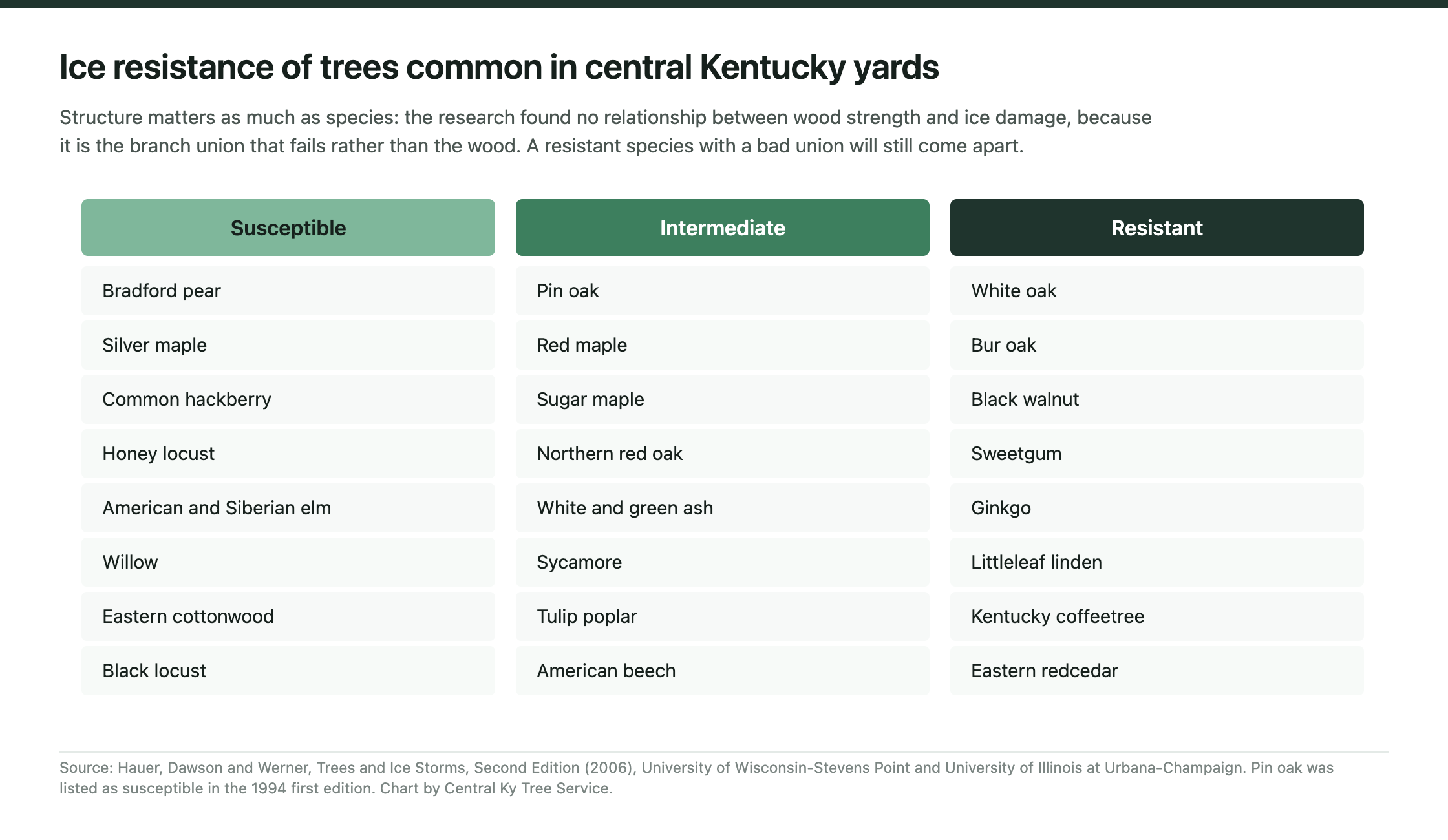
Species matters, and it has been studied properly. The second edition of Trees and Ice Storms by Hauer, Dawson and Werner, published jointly by the University of Wisconsin-Stevens Point and the University of Illinois at Urbana-Champaign, groups trees into three categories of ice resistance. These are the species most likely to be standing in a central Kentucky yard.
| Susceptible | Intermediate | Resistant |
|---|---|---|
| Bradford pear | Pin oak | White oak |
| Silver maple | Red maple | Bur oak |
| Common hackberry | Sugar maple | Black walnut |
| Honey locust | Northern red oak | Sweetgum |
| American and Siberian elm | White and green ash | Ginkgo |
| Willow | Sycamore | Littleleaf linden |
| Eastern cottonwood | Tulip poplar | Kentucky coffeetree |
| Black locust | American beech | Eastern redcedar |
The field data behind those categories is worth seeing. Measuring the percentage of trees of each species damaged in the 1990 Urbana storm, Hauer, Wang and Dawson recorded Siberian elm at 41.7 percent, honey locust at 12.7 percent, and Bradford pear and common hackberry both at 8.8 percent. Northern red oak came in at 0.6 percent, and Kentucky coffeetree and swamp white oak at zero. Of 501 conifers surveyed, only 0.6 percent sustained injury.
Two cautions on using this table. First, pin oak was listed as susceptible in the 1994 first edition and reclassified as intermediate in the 2006 second edition, so treat it as a borderline case. Second, these rankings come from open-grown urban trees in Illinois and Wisconsin. Kentucky forest observations differ: Jeff Stringer of the University of Kentucky Cooperative Extension Service, reporting on the 2009 storm, recorded severe damage in black cherry, black walnut, black oak, southern red oak, gum, soft maples and yellow poplar, with moderate damage in sugar maple and white oak. A forest-grown tree and a yard tree of the same species behave differently.
The practical takeaway: if you have a Bradford pear, a silver maple or a hackberry near the house, those are the trees to look at first.
What actually helps, and when to do it
This is where a lot of published advice goes wrong, so it is worth being precise about timing.
Structural pruning is best done in late winter or early spring, not fall. Dr. Rick Durham, Consumer Horticulture Extension Specialist at the University of Kentucky, addresses the autumn question directly: deciduous trees losing their leaves does not signal a time for pruning, and “the preferred time for pruning most woody plants is late winter to early spring,” because plants initiating growth in spring are better able to deal with cut surfaces. The Kentucky Division of Forestry agrees that the best time to prune limbs is during late winter or early spring.
Deadwood and hazard removal is different, and can happen now. Dr. Durham’s own exception covers it: damaged or diseased limbs may be removed at any time, as they present hazards to people and property, “particularly during winter when snow and ice add weight to branches.” The Kentucky Division of Forestry likewise advises removing dead, diseased or weakly-attached limbs promptly.
So the honest fall plan is: inspect now, take out the deadwood and the clear hazards now, and book the structural work for late winter. That sequence follows Kentucky extension guidance rather than working against it, and it still gets the risky material out of the tree before the ice arrives.
On what structural pruning buys you, the authors of Trees and Ice Storms are measured rather than promotional: trees pruned regularly from a young age “should be more resistant to ice storms as a result of removal of structurally weak branches, decreased surface area of lateral branches, and decreased wind resistance.” That is a reasoned expectation from the mechanism, stated as an expectation rather than a measured result. No published study puts a percentage on the reduction, so anyone who quotes you one is guessing.
Two rules govern how much can come off. The Kentucky Division of Forestry advises never removing more than one third of the live crown of a tree at once, and Purdue Extension gives a limit of 30 percent of the crown at one time. Both also advise against wound paint and against flush cuts.
Cabling and bracing has a narrow, real role. Where a valuable tree has co-dominant stems that cannot be pruned out, a support system can help. The governing standard is ANSI A300 Part 3, which covers the installation and maintenance of tree support systems including cabling, bracing and guying. Purcell of Purdue is clear about what it does and does not do: cabling and bracing “do not eliminate risk of tree failure, but when done correctly by a certified arborist, they can extend the life of a tree or make it safer.”
It is also a maintenance commitment, not an install-and-forget fix. Purdue recommends annual ground inspections for loose hardware and a closer inspection from within the tree roughly every three years, with systems potentially replaced after seven to ten years. Purcell notes that the better solution for co-dominant stems is to avoid them in the first place, or to remove or subordinate one of the stems early in the tree’s life. The tree trimming and pruning page covers the routine work that prevents most of these situations from developing.
The pre-winter walkaround checklist
Give yourself twenty minutes and a pair of binoculars. Work outward from the house.
- Look up into each tree near a structure. Any two trunks of similar size forming a narrow V, especially with a bark seam pinched between them, is a failure point. Note it.
- Find the deadwood. Bare branches with no fine twigs, peeling bark, or limbs that did not leaf out this year. These break first and they are the easiest thing to remove.
- Check what is over the roof, the driveway and the parked cars. Long horizontal limbs extending over something valuable carry the most leverage and cause the most expensive damage.
- Identify the species. Bradford pear, silver maple, hackberry, honey locust, willow and elm near a structure deserve professional eyes before winter.
- Look for old topping cuts. Flat-cut stubs with a cluster of thin upright shoots growing from them mean weakly attached regrowth in the upper canopy.
- Note anything leaning, or any cracked or split trunk. These are hazard-tree conditions, not pruning problems.
- Check clearance from the service line to your house. Branches resting on or near a line are a utility matter, not a homeowner one.
- Photograph anything that concerns you. It gives whoever assesses the tree something to work from and gives you a baseline for next year.
Anything in categories 6 or 7 should not wait for a pruning season. Those are candidates for removal or utility notification now.
What never to do during an ice storm
Do not knock, shake or beat the ice off branches. John Ball, Professor and Extension Forestry Specialist at South Dakota State University Extension, states it directly: “Do not knock the ice from trees and shrubs. This force may break branches as well as dislodge ice.” Aaron Steil of Iowa State University Extension and Outreach agrees: attempting to remove ice by beating branches with a broom or rake “will only cause greater damage,” and in most cases “it’s best to let the ice melt naturally.” The Kentucky Division of Forestry version is a single line: “Don’t work on ice-coated trees, let the ice melt.”
Do not go near a downed wire, and do not assume it is dead. LG&E and KU, the utilities serving this region, advise staying away from downed wires and keeping others away, and to “always assume any downed wire is an energized power line,” because there is no way to tell an energized line from a cable or telephone wire by looking. Their guidance also warns against clearing fallen limbs and debris that may be in contact with a downed line. Call 911 in an emergency, or KU at 800-981-0600.
Do not climb or work an ice-loaded tree yourself. The Kentucky Division of Forestry advises that removal of heavy limbs, and climbing large trees, should be left to certified arborists. The USDA notes that between 1995 and 2007 there were 407 tree-related human fatalities in the United States.
After an ice storm: what can be saved
Not every damaged tree needs to come down. Purdue Extension offers a general rule that branch failure “can be easily repaired and not lethal to the tree unless more than half the crown has been destroyed,” and that if more than 30 percent of the roots are exposed, removal may be the better option.
Jeff Stringer of the University of Kentucky Cooperative Extension Service gives thresholds that account for growth rate. Oaks and hickories regrow relatively slowly, so more than 30 percent top reduction is cause for concern. Faster species such as yellow poplar, cottonwood and black walnut can regenerate top damage more quickly, so the concern threshold is above 50 percent. Trees bent more than 50 to 60 degrees rarely recover fully, and a tree with the main stem below the crown broken, the entire top broken, or roots lifted should be removed.
The Kentucky Division of Forestry advises tackling immediate hazards first: dead trees, severely leaning trees, trees with broken or cracked stems, and trees with extensive broken roots. It also warns that hidden structural damage can surface over several growing seasons as twigs or branches in the upper crown begin dying, so a tree that looks fine in March may declare itself in July.
Frequently asked questions
How much ice does it take to damage trees?
The Midwestern Regional Climate Center at Purdue University reports that a quarter inch of ice results in some tree damage, while at half an inch or more “the major and crippling effects of ice storms occur.” For context, the National Weather Service recorded 0.55 inches of ice near Lexington in the January 2026 storm, and about an inch in the February 2003 event.
Should I knock the ice off my trees?
No. South Dakota State University Extension and Iowa State University Extension both advise against it, because the force you apply breaks branches that are already loaded and bent. Iowa State recommends letting the ice melt naturally. The Kentucky Division of Forestry gives the same advice.
When should I prune trees in Kentucky?
Late winter to early spring for structural pruning, according to Dr. Rick Durham of the University of Kentucky and the Kentucky Division of Forestry. Dead, diseased or hazardous limbs are the exception and can be removed at any time, which is why fall inspection and deadwood removal still make sense ahead of ice season.
Which trees are most vulnerable to ice damage?
Research published as Trees and Ice Storms by the University of Wisconsin-Stevens Point and the University of Illinois lists Bradford pear, silver maple, common hackberry, honey locust, elm and willow among susceptible species, with white oak, bur oak, ginkgo, littleleaf linden and Kentucky coffeetree among the resistant ones. Structure matters as much as species, since the research found branch union strength, not wood strength, drives failure.
Who is responsible for limbs on power lines?
Contact your utility rather than handling it yourself. LG&E and KU advise assuming any downed wire is energized and staying clear, including of branches and debris in contact with it. Call 911 if it is an emergency, or KU at 800-981-0600. A limb that has already come down on a structure is a different situation and is handled as emergency tree service.
Getting ahead of it
The trees that come down in a Kentucky ice storm are, with few exceptions, trees that had a visible structural fault beforehand. A narrow union, a load of deadwood, an old topping cut, a long limb over the roof. None of those are hard to spot in September. All of them are impossible to fix in January.
Central Ky Tree Service has worked through central Kentucky winters since January 2003, across Lexington and Fayette County and the surrounding service areas, including Georgetown, Versailles, Frankfort, Nicholasville, Winchester, Richmond, Paris, Lawrenceburg, Wilmore, Midway, Cynthiana and Mount Sterling. If you would like someone to walk your property before the weather turns, you can request a quote. If a tree has already failed, that is what our emergency service is for, and if a stump is left behind afterward we handle stump grinding too. More questions are answered on our FAQ page, and our post on ISA tree care standards explains the standards this work is done to.
Sources
- Midwestern Regional Climate Center, Purdue University: Ice Storms
- National Weather Service Louisville, The Blue Grass Ice Storm of February 2003
- National Weather Service Louisville, January 2009 Ice and Snow
- National Weather Service Louisville, Winter Storm January 24 to 26, 2026
- Hauer, Wang and Dawson, Ice Storm Damage to Urban Trees, Arboriculture & Urban Forestry 19(4)
- Hauer, Dawson and Werner, Trees and Ice Storms, Second Edition, University of Wisconsin-Stevens Point and University of Illinois
- Purcell, Large Tree Cabling and Bracing, Purdue Extension FNR-550-W
- Purdue Extension Forestry and Natural Resources, Trees and Storms
- Durham, Not the Time to Prune Trees and Shrubs, University of Kentucky
- Kentucky Division of Forestry, Proper Tree Pruning Techniques
- Kentucky Division of Forestry, Helping Trees Recover From Ice Storms
- Stringer, Ice Damage: Managing Woodland Damage and Health, University of Kentucky Cooperative Extension Service
- Ball, What to Do About Ice Covered Trees, South Dakota State University Extension
- Steil, How to Prevent Ice and Snow Damage on Trees and Shrubs, Iowa State University Extension and Outreach
- LG&E and KU, Downed Power Lines
- USDA Climate Hubs, Maintain Trees and Remove Hazards