Likely brought to the US in a shipping container, the emerald ash borer is an Asian beetle that kills untreated ash trees of all types within about five years of first contact. With proper care ash trees can be protected against it. It is established in Kentucky, so if you have an ash on your property and you are doing nothing, the tree is on a clock.
Plenty of people are worried about a tree that is not an ash at all. Three things to check together.
All three together means ash. If you are not sure, send us a photo of the bark and a leaf and we will tell you.
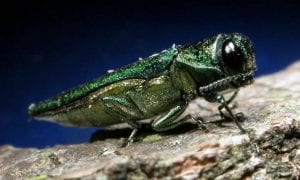
Absolutely. The emerald ash borer has unfortunately made its way to Kentucky, and most native ash trees, if left untreated, will die. This is not being taken lightly. Even the University of Kentucky is working on the problem, and its entomology department publishes a detailed identification guide with photographs that is worth a look before you call anyone.
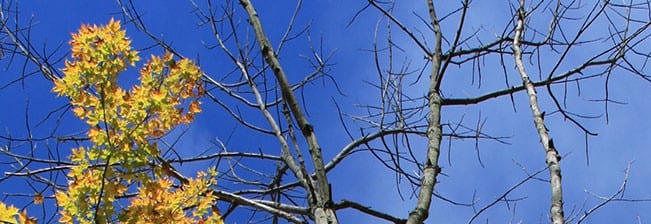
An ash tree killed by Emerald Ash Borer infestation
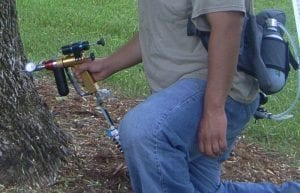
Ash trees can be protected by use of insecticides. These are systemic, meaning the tree takes them up and moves them through its own tissue, so they reach the larvae feeding under the bark where a spray cannot get. Because the product works inside the tree rather than as a surface application, it is not drifting onto other plants or coating the yard. For more information on insecticide use for ash trees, reference EmeraldAshBorer.com.
This is the part that decides everything and the part most sites skip.
Treatment protects a tree that still has a functioning canopy. The general working threshold is that an ash with more than half its crown intact is a good candidate, and one that has already lost most of its canopy is not. The insecticide moves through living tissue, so a tree that has lost that tissue cannot distribute it. Past a certain point, treatment is money spent on a tree that is going to die anyway.
The other half of the decision is what the tree is worth keeping for. A mature ash shading the west side of a house is worth protecting on an ongoing basis. A volunteer ash in a fence row usually is not. Treatment is also not one and done, it is a repeating cycle for as long as you want the tree kept, and it goes on in spring rather than after the damage is visible for the season. We will give you our honest read and you decide.
This is the most important thing on this page for anyone who has already lost an ash.
Most dead trees stay sound for years and can be taken down at a normal pace. Ash killed by borer does not. It dries and goes brittle quickly, limbs shed without warning, and the wood loses the strength a climber relies on. Within a year or two of death a standing dead ash is a genuinely hazardous removal, and it only gets worse from there.
If an ash on your property is already dead, do not put it off another season. See tree removal in Lexington, KY.
Can I treat it myself? There are homeowner soil drench products. They work better on smaller trees than large ones, and timing and dose are where people go wrong. On a big landscape ash it is worth having done properly.
My neighbor has an infested ash. Is mine at risk? Probably soon. The beetles move, and an untreated ash within a few hundred yards of an infested one is at real risk.
Should I just replace it? On a small or poorly placed ash, often yes. Take it out, plant something else, and stop paying to defend it.
How fast does it kill? An untreated ash that has been found typically dies within a few years of the first damage.
Can you prune out the dead parts instead? On a tree in early decline, deadwood removal is part of the plan. See tree trimming and pruning. It does not stop the beetle on its own.
We assess and treat ash trees at homes, farms and businesses in Lexington, Nicholasville, Wilmore, Georgetown, Versailles, Midway, Frankfort, Lawrenceburg, Paris, Cynthiana, Winchester, Mount Sterling, Richmond and Berea. For a thorough needs assessment, call 859-333-7246 for a free consultation.