
If your ash tree is losing leaves from the top down, has smooth blond patches where woodpeckers have stripped the outer bark, and shows 1/8-inch D-shaped holes in the trunk, it has emerald ash borer. In Fayette County the beetle has been here since 2009, so the question is usually no longer whether a tree is infested, but how far along it is.
Emerald ash borer arrived in Kentucky on May 18, 2009, when it turned up in two places at once. The Kentucky Division of Forestry found it in Shelby County, and the Office of the State Entomologist at the University of Kentucky found it in Jessamine County. One of the two original detections was effectively on Lexington’s doorstep.
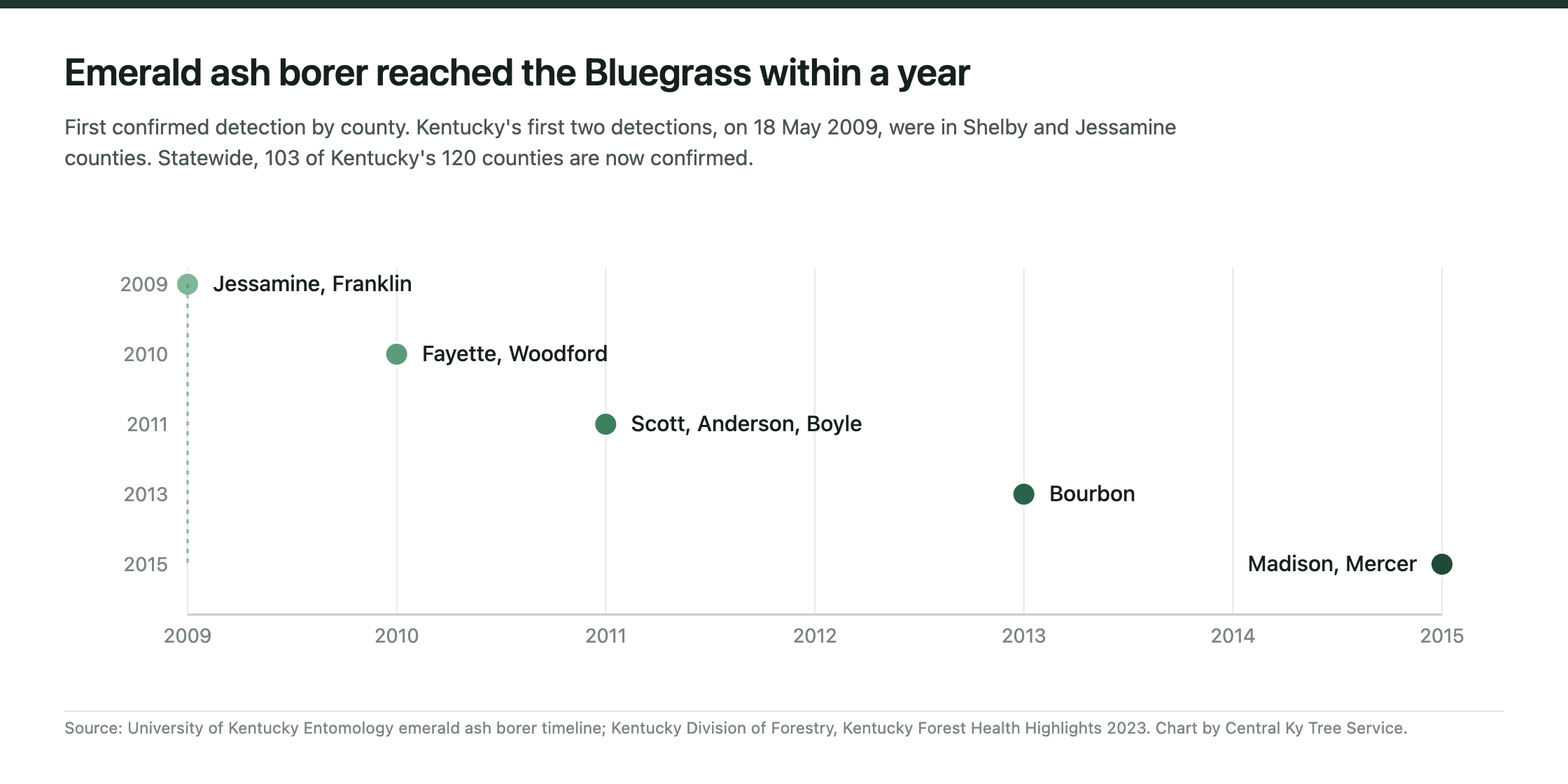
Sixteen years later the situation across the Bluegrass is settled. The Kentucky Division of Forestry reported in its Kentucky Forest Health Highlights 2023 that the beetle has now been confirmed in 103 of Kentucky’s 120 counties, and that it “will eventually impact ash resources across the entire state.” Central Kentucky is well past the arrival phase. Most of the ash still standing here has either been treated, is being eaten right now, or is dead and has not fallen yet.
This guide walks through how to identify an ash tree, what the symptoms look like in the order they actually appear, and the point at which treatment stops making sense and removal becomes the answer.
First, make sure it is actually an ash tree
Plenty of trees get diagnosed with emerald ash borer that were never ash to begin with. Three features narrow it down quickly.
Ash trees have opposite branching. Twigs, buds and leaves emerge in matched pairs directly across from each other rather than staggered along the stem. Only a short list of trees does this, and most trees in a Kentucky yard do not.
Ash leaves are pinnately compound. What looks like a single leaf is actually a stalk carrying five to eleven leaflets. People routinely mistake a leaflet for a leaf and conclude the tree is something else.
Mature ash bark carries a tight diamond pattern of interlacing ridges, most obvious on older white ash. The University of Kentucky Department of Forestry and Natural Resources lists four ash species native to the state: white ash, green ash, blue ash and pumpkin ash. Blue ash is the signature tree of the Bluegrass region and is distinguishable by its four-sided, corky-winged twigs.
The scale of what is at stake locally is easy to underestimate. Citing Kentucky Division of Forestry data, the University of Kentucky Department of Entomology puts the state’s inventory at 130.9 million stems of white ash and 92.5 million stems of green ash.
The symptoms, in the order they appear
Emerald ash borer does its damage out of sight. The larvae feed in the phloem just under the bark, cutting the tree’s supply lines, so the visible symptoms are downstream effects that show up in a fairly reliable sequence.
1. Woodpecker blonding, often the first thing you notice
Before most homeowners spot anything on the trunk, they notice the tree looks oddly pale in patches. Purdue University Extension calls this heavy woodpecker activity producing “blond” areas. Lenny Farlee, Extension Forester at Purdue, explains the mechanism plainly: ash bark is grey on the surface but the inner bark is a light corky tan, so when woodpeckers strip the outer layer to reach the larvae underneath, the exposed patches look bleached.
The Wisconsin Department of Natural Resources calls the same symptom “flecking” and notes that it usually starts in a tree’s canopy and works down the tree over the following years if the tree is not treated. It is not a subtle sign once you know to look for it, and it is visible from the street.
It is also worth knowing how severe this sign is. Purdue states that trees with this much inner bark exposed indicate an advanced infestation and signal ash tree mortality in the next year or two. Woodpecker damage is not an early warning. It is a late one that happens to be easy to see.
Researchers with the USDA Forest Service Northern Research Station have found that woodpeckers can eat up to 85 percent of the emerald ash borer larvae in a tree. That is not enough to save it, but it explains why the birds work an infested ash so hard.
2. Canopy thinning and dieback, from the top down
Purdue University Extension describes dieback of leaves that starts in the upper third of the tree. This direction matters for diagnosis. Most other problems, including root damage, drought stress and construction injury, do not produce a neat top-down pattern.
The University of Kentucky’s ENTFACT-453, written by extension specialists Jonathan Larson and Ellen Crocker, lists branch dieback in the upper third of the canopy among the early signs. The Wisconsin Department of Natural Resources notes thinning of leaves at the top of the tree within one to three years of infestation.
This is the symptom that decides what happens to the tree, because the percentage of canopy lost is what determines whether treatment is still worth attempting. It can only be judged with leaves on the tree, which makes late summer and early fall the window for making that call.
3. Epicormic sprouting at the base and along the trunk
A stressed ash will push out shoots from dormant buds low on the trunk, a response arborists call epicormic sprouting. Purdue describes water sprouts at the bottom of the tree’s trunk; the University of Kentucky refers to suckers on the lower trunk. The tree is attempting to grow new leaves below the damage, using the only tissue that still has a working connection to the roots.
4. D-shaped exit holes
This is the diagnostic sign, and the shape is the whole point. Adult beetles chew their way out through a hole with one flat side and one curved side, roughly 1/8 inch across, as documented by both Purdue University Extension and the University of Kentucky’s emerald ash borer field guide.
Kentucky has native borers that attack ash, and their exit holes look different. Daniel A. Herms, writing for Ohio State University Extension in fact sheet ENT-77, sets out the distinction: emerald ash borer holes are distinctly D-shaped and small at about 1/8 to 1/4 inch, while clearwing and lilac-ash borers make holes that are larger at 1/4 to 3/8 inch and round, and the redheaded ash borer makes large oval exit holes at 1/4 to 3/8 inch wide.
Exit holes start high in the tree and appear lower over time. The University of Kentucky notes that as an infestation progresses, D-shaped holes become more obvious at eye level. If you can see them from the ground, the tree has been infested for a while.
5. S-shaped galleries under the bark
Lift a piece of loose bark and the evidence is unmistakable. Purdue describes S-shaped or hairpin-turn-shaped channels, often filled with a sawdust-like material called frass. The University of Wisconsin-Madison puts gallery width at approximately 1/8 inch. Ohio State’s Herms notes that emerald ash borer larvae pack their frass tightly within their galleries and confine their feeding to the phloem tissue just under the bark.
The larvae themselves are also distinctive. Herms describes them as highly flattened, with what he calls a tapeworm-like profile.
6. Vertical bark splits
Both Purdue and the University of Kentucky list vertical splits in the bark among the visible signs. These form where the tree’s tissue has been so heavily tunnelled underneath that the bark cracks open, and a split will often reveal a gallery directly beneath it.
7. The beetle itself, May through July
The University of Kentucky describes the adult as a small metallic green beetle, half an inch long and about 1/8 inch wide. The Wisconsin Department of Natural Resources offers a comparison that sticks: about the size of one grain of cooked rice. The University of Kentucky’s field guide gives the window for spotting adults in Kentucky as May through July.
Purdue adds a useful filter for the many green beetles people find in their yards and worry about. Emerald ash borer has a squared-off head, a straight body and a rear that tapers to a blunt point, and anything larger than a dime is not this insect.
How bad is it? The canopy question that decides everything
Once a tree is confirmed infested, one number drives the decision: how much of the canopy is already gone.
A bulletin produced jointly by entomologists at Ohio State, Michigan State, Purdue, the University of Wisconsin and the Illinois Department of Agriculture states it directly: “If a tree has lost more than 50 percent of its canopy, it is probably too late to save the tree.” The University of Kentucky’s ENTFACT-453 reaches the same place from the other direction, advising removal for trees with less than half of their canopy remaining.
Purdue University Extension is more conservative, holding that trees which have lost more than 30 percent of their canopy should not be treated with insecticides because too much of the tree is already dead.
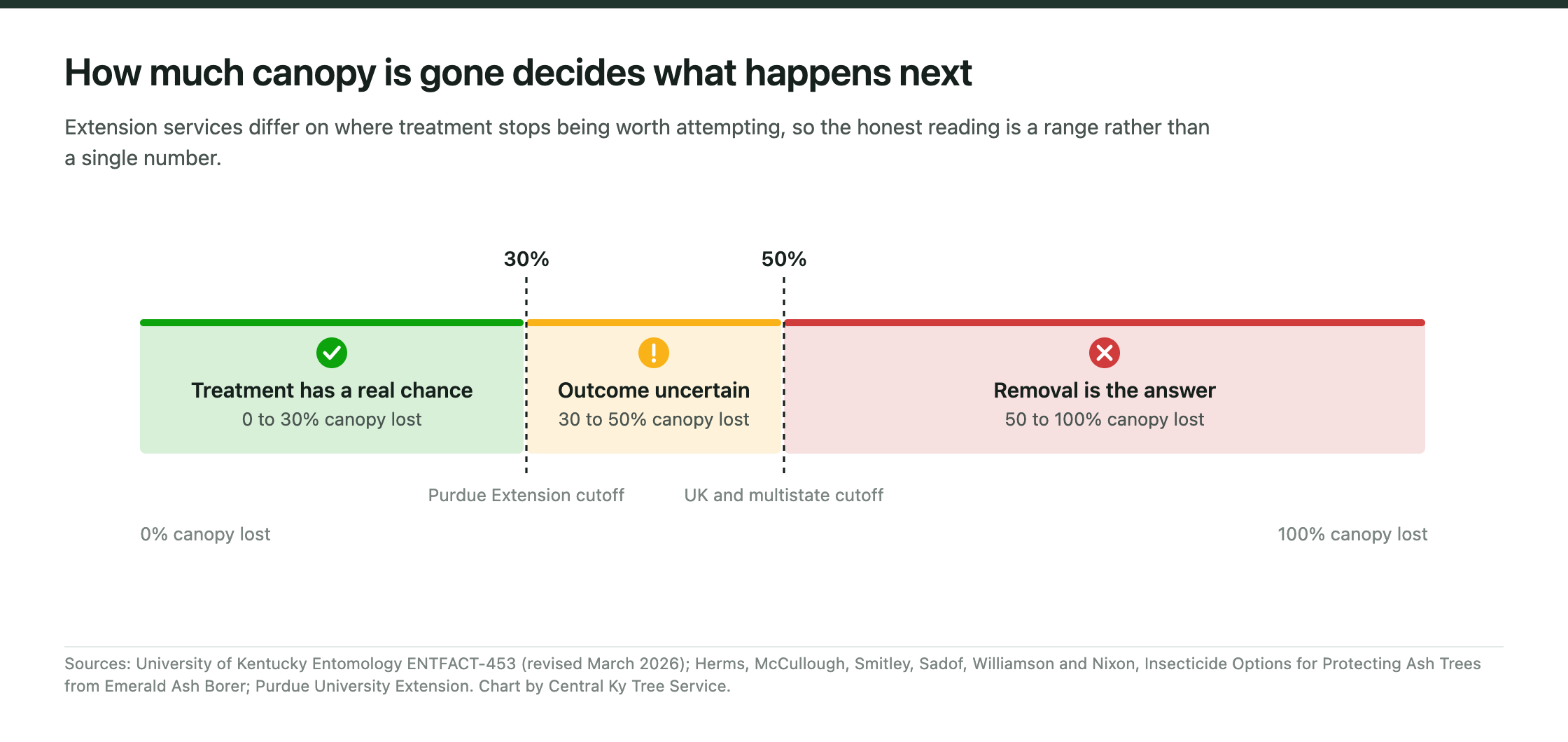
Read together, these give an honest working range. Below roughly 30 percent canopy loss, treatment has a real chance. Between 30 and 50 percent, the outcome is uncertain and you are gambling on a tree that may die anyway after several years of treatment cost. Above 50 percent, extension services across the region agree the tree is not coming back.
Timelines vary more than most articles admit, and the University of Kentucky itself publishes two figures. ENTFACT-453, revised in March 2026, states that white and green ash can usually survive an infestation for seven to ten years before succumbing, while noting that heavy beetle pressure or an already-stressed tree can cut that to one or two years. The University of Kentucky’s Tree Pest Guide gives three to five years. What both agree on is the endpoint: the Tree Pest Guide calls emerald ash borer “100% lethal for untreated ash trees.”
Why a dead ash is a different removal job
This is the part most homeowners do not know, and it is the reason waiting is expensive rather than free.
Ash does not stay sound after it dies. The USDA Forest Service Northern Research Station states that dead ash wood rapidly becomes brittle, and that tree limbs and whole trees fall as a result.
Research published in Arboriculture & Urban Forestry by Persad and colleagues put numbers to how quickly this happens. Their work on the structure and material properties of infested ash found that degradation can be identified as early as one to two years after infestation, well before the tree looks dead. Under static load testing, branch failure at the union occurred only in the infested trees.
The same paper records something that matters directly to anyone standing under one of these trees. The authors note that several cases exist in northwest Ohio where infested ash branches or stems failed prematurely during deadwood pruning or whole tree removal. The wood gives way during the work, not just in a storm.
The practical consequence is straightforward. A declining ash that still has structural integrity can be climbed and dismantled in a normal way. A long-dead ash may need a bucket truck or a crane, cannot be safely climbed, and costs more to take down because of it. The same tree gets more dangerous and more expensive every season it stands. If you are weighing tree removal against another year of waiting, that is the trade you are actually making.
This kind of work is governed by ANSI Z133, the industry safety standard for arboricultural operations, covered in more detail in this guide to ANSI Z133 arboricultural safety.
Treatment, and the point where it stops paying
Treatment works, but it is a commitment rather than a cure. The University of Kentucky’s ENTFACT-453 sets out the practical split by tree size: trees under 15 inches in diameter at breast height can be treated by homeowners with a soil drench, with April and May the optimal timing, while trees over 15 inches require professional application by trunk injection, soil injection or basal bark spray.
The multistate bulletin adds that soil-applied imidacloprid is most effective on smaller trees and that control on trees exceeding 15 inches is less consistent. Emamectin benzoate, applied by trunk injection, gives the longest protection, and the University of Kentucky notes it can last up to three years where other systemic products need annual application.
There is also a distance rule that used to guide the decision. The multistate bulletin advises that trees within 10 to 15 miles of a known infestation may be at risk, and that beyond 15 miles it is probably too early to begin treatment. In Fayette County that test is no longer meaningful. With 103 Kentucky counties confirmed and local detections dating to 2009, every ash tree in central Kentucky is well inside the zone where treatment is warranted if you intend to keep the tree.
Treatment is worth it for a specific kind of tree: one in good condition, below the canopy-loss threshold, in a location where a mature shade tree is genuinely valuable, and belonging to an owner prepared to keep paying for it indefinitely. For a tree that is already thinning badly, or one that would not be replanted in the same spot anyway, the money is better spent on removal and a replacement species.
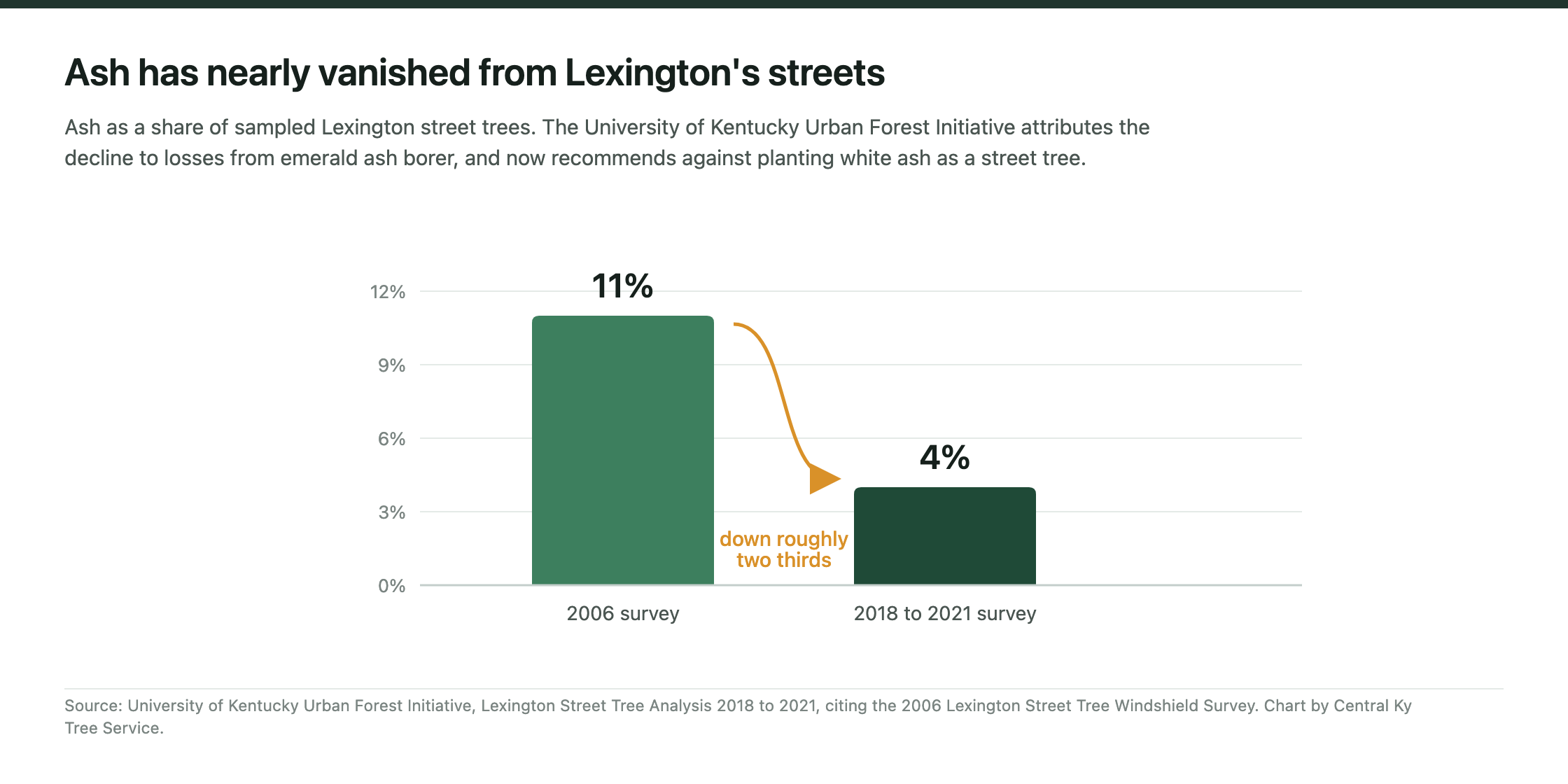
Lexington has already made this calculation at city scale. Research by the University of Kentucky Urban Forest Initiative found that ash made up 11 percent of Lexington’s street trees in a 2006 survey, but only 4 percent by the 2018 to 2021 analysis, a decline the report attributes to losses from emerald ash borer. The report goes on to recommend against planting white ash as a street tree for the same reason.
When to look, and what you can see in each season
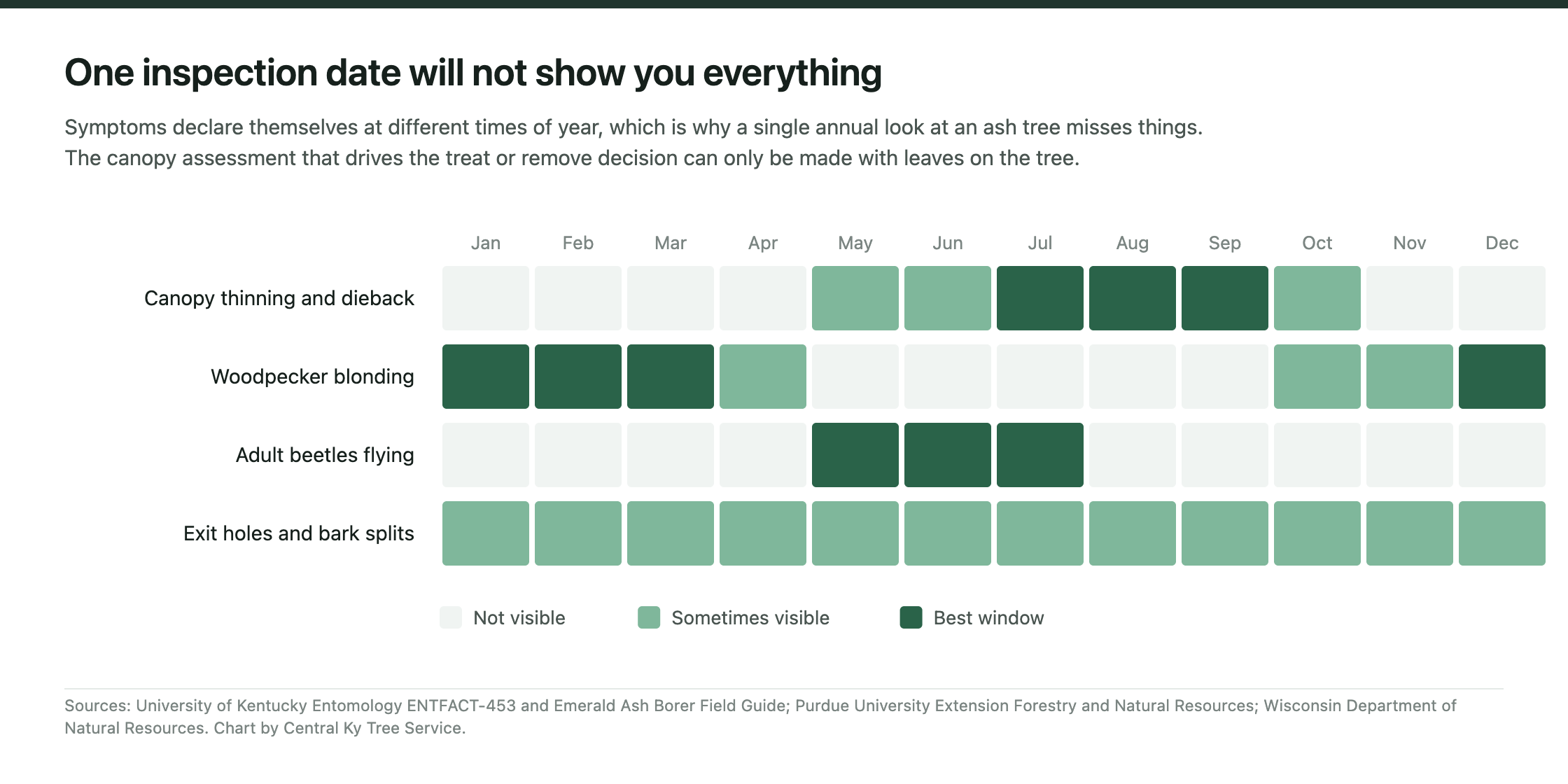
Different symptoms show themselves at different times of year, which is why a single inspection date is the wrong way to think about it.
Late summer and early fall is when the canopy can be assessed. Leaves are fully out, so thinning and dieback in the upper third are measurable, and that percentage is what drives the treat-or-remove decision. If you are going to make a call about a tree this year, this is the window for it.
Winter and early spring is when woodpecker blonding shows best. Purdue’s extension forestry work places woodpecker feeding on emerald ash borer larvae in winter and early spring, and bare branches make bark detail and overall crown structure far easier to read from the ground.
May through July is when adults are flying in Kentucky, per the University of Kentucky’s field guide, and the only time you have a realistic chance of seeing the beetle itself.
Exit holes and bark splits can be found year-round, but they show up later in an infestation and become easier to see at eye level as the tree declines.
Frequently asked questions
Can an infested ash tree be saved?
Sometimes, depending on how far the infestation has progressed. Extension guidance from the University of Kentucky and a six-institution multistate bulletin puts the cutoff at roughly 50 percent canopy loss, beyond which treatment is not expected to save the tree. Purdue University Extension sets a more cautious line at 30 percent. A saved tree also needs ongoing treatment rather than a single application.
Is it safe to leave a dead ash tree standing?
Not for long. The USDA Forest Service states that dead ash wood rapidly becomes brittle and that limbs and whole trees fall. Research in Arboriculture & Urban Forestry found structural degradation beginning within one to two years of infestation. A dead ash near a house, driveway, fence or power line should be treated as a hazard tree, and if one has already failed, that becomes an emergency tree service call rather than a scheduled job.
Do I need a permit to remove an ash tree in Lexington?
Under Section 17B-3 of the Lexington-Fayette Urban County Government Code of Ordinances, removing a tree larger than three inches in diameter generally requires a permit from the Division of Environmental Services. The ordinance provides an exemption for trees that are dead or dying, which covers most emerald ash borer removals, and street trees carry separate replacement obligations. The local rules are covered in more depth in this guide to LFUCG tree regulations.
What does an emerald ash borer look like?
The University of Kentucky describes the adult as a metallic green beetle about half an inch long and 1/8 inch wide, with a metallic purple-red abdomen beneath the wing covers. The Wisconsin Department of Natural Resources compares it to a single grain of cooked rice. Purdue notes it has a squared-off head and a blunt tapered rear, and that any green beetle bigger than a dime is something else.
What happens to the stump after an ash is removed?
Removal leaves a stump unless grinding is included in the work. Because dead ash roots decay slowly and the stump will resprout in some cases, most homeowners have it ground out at the same visit rather than as a separate job later. The stump grinding page covers how that works and what is left behind.
Getting a look at your ash trees
If you have an ash in the yard and you have not looked closely at it in a few years, this is the season to do it, while the canopy still tells you something. Walk the tree, look up at the top third, and check the trunk for blond patches and D-shaped holes.
Central Ky Tree Service has been working on trees in Lexington since January 2003, across Fayette and the surrounding counties, including Georgetown, Versailles, Frankfort, Winchester, Richmond, Paris, Lawrenceburg, Wilmore, Midway, Cynthiana and Mount Sterling. If you would like someone to look at a tree and tell you honestly where it sits, you can request a quote or read more on our emerald ash borer service page. Other common questions are answered on our FAQ page, and if the tree turns out to be healthy, regular tree trimming is the cheaper way to keep it that way.
Sources
- University of Kentucky Entomology, ENTFACT-453: Emerald Ash Borer FAQs for Kentuckians
- University of Kentucky, Kentucky CAPS Program: Emerald Ash Borer
- University of Kentucky Entomology, Emerald Ash Borer Field Guide
- University of Kentucky Urban Forest Initiative, Lexington Street Tree Analysis 2018 to 2021
- Kentucky Division of Forestry, Kentucky Forest Health Highlights 2023
- Purdue University Entomology Extension, Emerald Ash Borer Identification
- Purdue University Entomology Extension, Emerald Ash Borer Management
- Ohio State University Extension ENT-77, Distinguishing Emerald Ash Borer from Native Borers
- Wisconsin Department of Natural Resources, Emerald Ash Borer Signs and Symptoms
- Persad et al., Effects of Emerald Ash Borer Infestation on the Structure and Material Properties of Ash Trees, Arboriculture & Urban Forestry 39(1)
- USDA Forest Service Northern Research Station, Knight, Flower and Nelson
- USDA APHIS, Emerald Ash Borer
- Lexington-Fayette Urban County Government, Code of Ordinances Section 17B-3